Principal Data Platform Architect
Gold products leave the boundary only through governed data product contracts.
Portfolio
Things I built and ship. Each card opens the live surface or repository.
GitHub
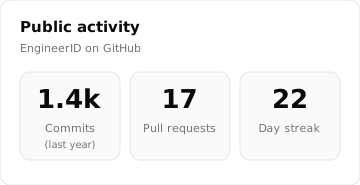
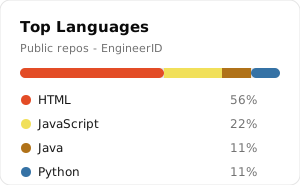
Public EngineerID profile and public, non-archived repositories on EngineerID and Ambient-Team. Star, fork, and issue counts appear when the Pages build snapshot is above zero.
Contribution graph
Year-view activity for EngineerID. The summary cards above support quick scanning. GitHub hosts the full graph for detail.
View full profile on GitHubSelected repositories
EngineerID|Ambient-Team
Background
I build a governed lakehouse on Databricks with Unity Catalog. Gold leaves only through governed adapters. Ambient Core stays open source under the MIT License, as the core under Ambient Systems. I appear as inventor onWIPO WO/2022/240365.
I am founder and sole director of Ambient Systems Limited, a Hong Kong private company limited by shares (Companies Registry number 3340310), incorporated 21 November 2023, status Live. Solutions Flux d'IA Inc. in Quebec dissolved 30 June 2026 as historical record. Ambient Systems Limited is the sole active company. It is pre-revenue, and validation work is ongoing. I keep bases in Toronto and Hong Kong. Product identity:ambientsystems.ai
The through-line from Deloitte through Centennial is below.
Through-line (2013-2024)
| Situation | Role | Actions | Outcomes |
|---|---|---|---|
| Deloitte Nineteen engagements across financial services and energy; one mining client needed energy cost down. | Analyst for controls and analytics tied to operating numbers. | I delivered computer-assisted audit technique controls testing and energy models on operational data under consulting delivery constraints. | Roughly 12 percent lower energy cost on the mining engagement. |
| SunFarmer A $2M procurement with operating cost at stake. | Senior product manager for procurement and the data path. | I ran procurement at SunFarmer and SEED Energy and delivered data products and automation on commercial and operations levers. | Procurement and operations cost reduction where measured at roughly 40 percent versus market and operations baseline. |
| Rotman A $25M incubator (2,000+ organizations) with audit expectations on program data. | Technology project manager for program-scale governance. | I structured data flows, reporting, and controls so stewardship and lineage stayed visible to operators and reviewers. | Audit-ready portfolio reporting at program scale. |
| Centennial Regulated post-secondary cohorts (~25 students) in AI, cloud, and data. | Sessional professor and principal investigator. | I delivered curricula in artificial intelligence, machine learning, cloud, and analytics, and led industry research pipelines and convolutional neural network models as principal investigator. | Teaching and research with lineage and control in view each cohort. |
 UofT Civil and Mineral Engineering
 Google Cloud Hackathon
 Governor General of Canada
Support / Pay me directly
Optional ways to support Ivan directly. Contract work stays separate; these links are not invoices or engagements.